The Eye of the Soul


There are moments in life when everything feels too close. The problem in front of you becomes the whole world. The emotion inside you becomes the whole truth. You don’t just experience what is happening — you become it. And in that state, it is almost impossible to see clearly, because everything is happening from inside the storm.
But there is another way of looking.
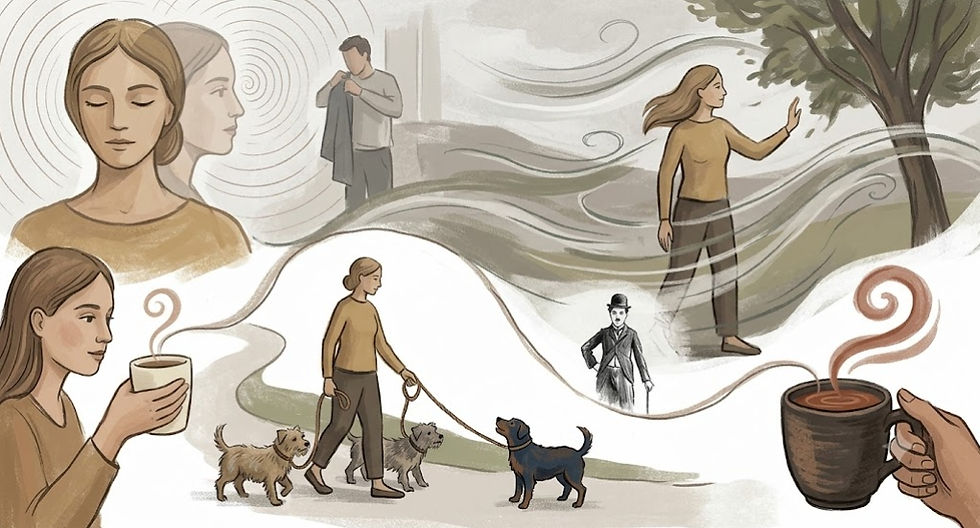
Not a way that denies what you feel, and not a way that tries to escape it, but a way that gives you distance — enough space to see without being swallowed by it. It’s the difference between being inside a wave and watching the ocean.
When I say “zoom out,” I don’t mean overthinking or analyzing yourself endlessly. It’s almost the opposite. It’s a quiet shift in perspective, like something in you steps slightly back and remembers that you are not only this moment, not only this reaction, not only this feeling.
There is something in you that has been here longer than this situation. Something that has carried you through many versions of yourself, many changes, many endings and beginnings. It doesn’t panic in the same way the mind does. It doesn’t rush to conclusions. It simply sees.
From that place, your problems don’t disappear, but they change shape. They become something you are going through, not something you are.
And this is where things start to get confusing for most people, because everything inside is usually called “feeling.” But not everything that rises within you belongs to the same layer of truth.
Some of what you feel is emotional reaction. It moves quickly. It reacts to fear, memory, expectation, old wounds, and imagined outcomes. It can feel very real in the moment, but it is often shaped by the past or the future rather than what is actually here.
And then there is something else. Something quieter. It doesn’t arrive with urgency. It doesn’t try to convince you. It doesn’t spiral or multiply. It is more like a simple recognition — a knowing that doesn’t need proof in the moment.
Most people have experienced it at some point. A sense of “this is right” or “this is not for me,” even when there is no logical reason yet. It doesn’t shout. It doesn’t compete with emotion. It just stays steady underneath it.
The difficulty is that we are not taught to separate these two. So everything gets bundled together. Fear feels like intuition. Intuition gets dismissed as fear. Emotional intensity gets mistaken for truth simply because it is loud.
But emotion is not the enemy. It is not something to shut down or rise above. Emotion is information. It shows you where something in you is alive, where something is unsettled, where something is asking to be understood.
The problem is not emotion itself — it’s what happens when we become it completely.
When sadness becomes identity. When anxiety becomes reality. When anger becomes the only lens we look through. In those moments, there is no space left to see anything else.
But if you can stay just a little bit wider than what you feel, something changes. You start to witness it instead of merging with it. You can feel something fully without becoming lost in it. You can let it move through you without turning it into a definition of who you are.
And underneath all of it, there is still that quieter layer. The one that doesn’t react but recognizes. The one that doesn’t get pulled in but remains aware. The one that sees more than just the immediate emotion of the moment.
That is what I call the eye of the soul.
Not something separate from you, and not something you need to reach outside of yourself, but something you already are when you are not completely identified with your reactions.
From that place, life doesn’t necessarily become easier, but it becomes clearer. You stop believing every emotional wave is the final truth. You stop collapsing into every passing state. And slowly, you begin to trust something steadier within yourself — something that is not shaken by every internal storm.
And that changes everything.
Nurit


Comments